Clean Cities, Blue Ocean Program Presents Panen Omset 2.0 to Encourage Business Digitalization in a Sustainable Direction
Makassar, 25 September 2023 – The Clean Cities, Blue Ocean Program by USAID together with SIRCLO, Waste4Change, Lestari Mulia Foundation has completed the Panen Omset 2.0 Program training class in Makassar (23/9/23). With the theme “Sustainable MSMEs Business”, Panen Omset 2.0 was held with the aim of accommodating the digitalization needs of MSME businesses and encouraging them to implement sustainable business supported by workshops and training activities with many expert trainers in their fields.
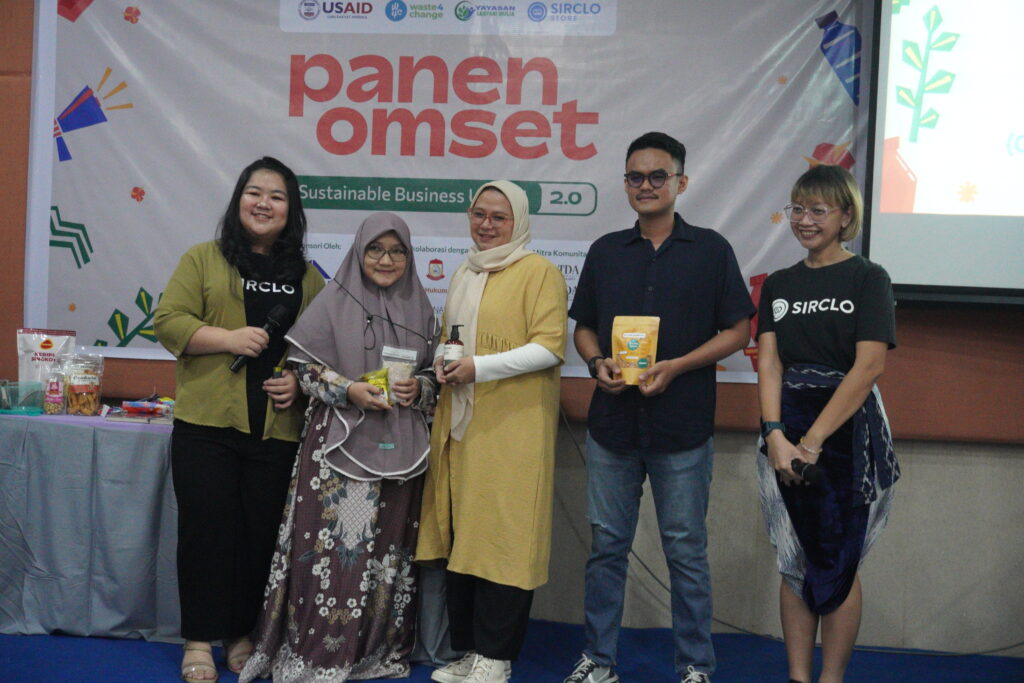
As many as 100 MSMEs in the city of Makassar participated in training activities. The material shared includes discussions about digital business management, digital marketing and branding, and tips related to live shopping streaming, which is currently one way to introduce and promote businesses to a wide audience. Also introduced were the Sirclo Store and Red Tree Asia platforms to provide various case studies and tricks in optimizing social media as a sales channel.
Panen Omset 2.0 Training
Makassar Turnover Harvest, which is part of the Clean Cities, Blue Ocean program series, also invited Rappo and Red Tree Asia as expert speakers. Apart from discussing business digitalization, there was also socialization regarding the Reduce, Reuse, Recycle (3R) concept with resource persons and local environmental heroes.

Saka Dwi Hanggara as Solid Waste Management Campaign Expert Waste4Change said, “it is not only economic benefits that must be considered, but also how businesses can participate in overcoming global carbon and emissions issues through responsible waste management activities. “It is hoped that the business being held can bring benefits to owners, employees, consumers, the environment and the community in order to help minimize environmental problems in the surrounding area.”
Based on data from the Ministry of Cooperatives and Small and Medium Enterprises (Kemenkop UKM Indonesia) in 2021, the contribution of Micro, Small and Medium Enterprises (MSMEs) to Indonesia’s Gross Domestic Product (GDP) was 61.07%. With this figure, MSMEs are a sector that is considered capable of surviving the COVID-19 pandemic and the global economic crisis.
Therefore, the Government has targeted 30 million MSMEs to go digital by 2024 so that MSMEs can reach a wider market. Of this target, it is recorded that 20.5 million MSMEs have gained access to digital business and the remaining 9.5 million still need to be encouraged to implement digitalization in their business.
“This turnover harvest activity not only collaborates with the Waste4Change SIRCLO program, it also collaborates with the Lestari Mulia Foundation and is part of the Clean Cities, Blue Ocean program, a collaboration between the Indonesian Government and the United States in order to provide efforts to reduce plastic waste in Indonesian oceans, ” said Maria Sael, Senior Business Development Executive at SIRCLO.

In the Digital Marketing socialization material, Rangga Prayuga, Founder of Red Tree Asia, explained the importance of designing every marketing strategy for a brand. One of the strategies will be implemented on digital platforms. Products that are created by humans and will be sold to humans need to be given a certain identity so that they can be easily recognized. A brand needs branding and promotion to be able to reach the minds of the wider public and ultimately be remembered and sought after. There are no wrong or right marketing ideas, only marketing that is right and in line with targets.
A sustainable business must be able to manage its business based on three elements called 3P or Triple Bottom Line Concept, namely People, Planet and profit. Rappo Indonesia, a social enterprise offers recycling products for single-use plastic bags in collaboration with the community, especially women’s groups in the Untia Coastal Area, Makassar City. The establishment of Rappo was due to 2 main problems, namely environmental issues (recycling plastic waste) and social issues (eliminating poverty).
Rappo focuses on empowering local tailors, communities in underprivileged areas and coastal areas of Makassar City. This empowerment aims to have a positive impact on women in Makassar City and of course also on the environment.
Akmal Idrus, S.H. as Founder of Rappo Indonesia explained, “wanting something is easy but what is difficult is doing it, because one of the problems in MSMEs is social inequality. We invite and collaborate with communities, business owners and individuals to jointly collect plastic bag waste from their respective environments with the aim of reducing plastic waste that is not managed properly. “Not only will it produce a positive impact in terms of the economy, it is hoped that MSMEs can also produce good changes for the environment.”
About Clean Cities, Blue Ocean
Clean Cities, Blue Ocean is USAID’s flagship program to combat marine plastic pollution. This five-year (2019-2024) $48 million program works at a global level and specifically, in countries focused on rapid urbanization to target marine plastics directly to the source. By strengthening waste management and advancing or building a circular economy, city by city, USAID is building sustainable solutions that reduce plastic in the oceans while empowering vulnerable populations and reducing pollution that impacts human health and our climate.
In Indonesia Clean Cities, Blue Ocean works with the Semarang, Makassar and Ambon City Governments to improve systems and governance, as well as behavioral changes in waste management. Other partners include national and local governments, private sector members, non-governmental organizations, and local women’s and youth organizations. For further information please visit this page https://urban-links.org/issue/ocean-plastic-pollution/ .